Virtual Observation Model (VOM)
A New Approach to AI-Driven Physical Automation
THE PROBLEM
Robotic automation has transformed industrial manufacturing, but its implementation remains expensive, time-consuming, and dependent on specialized engineering skills.
Conventional robotic systems require programmers and engineers to translate desired physical operations into machine-specific instructions, coordinated movements, and control sequences.
Even relatively simple applications can require substantial engineering effort, integration costs, and lengthy development schedules.
Modifying an existing operation often requires additional programming, testing, and technical support.
These barriers limit the economic feasibility of automation, particularly for smaller businesses and applications requiring frequent changes.
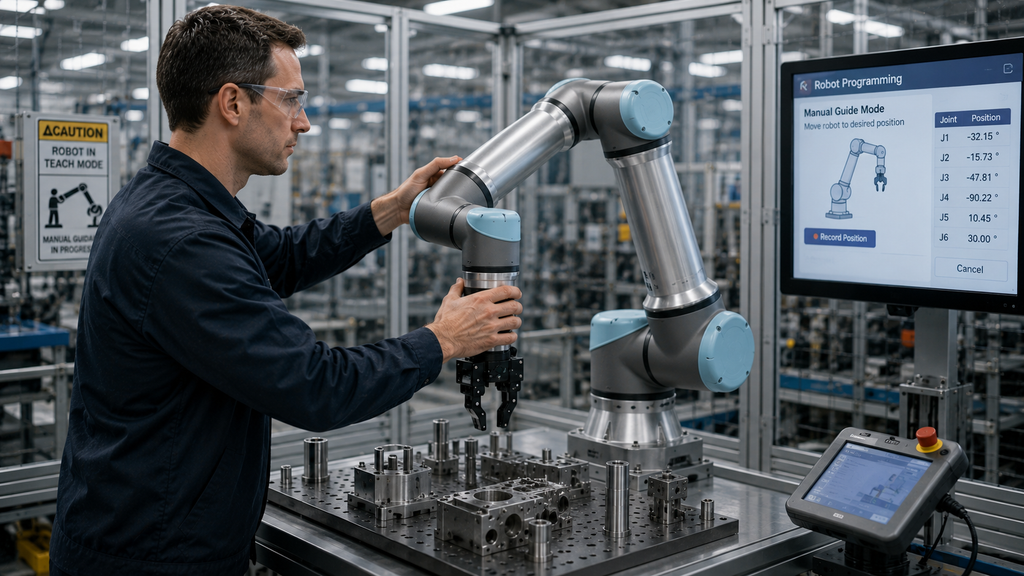
CONVENTIONAL ROBOT PROGRAMMING
Programming robotic operations requires specialized engineering skills, time, and technical resources.
OUR TECHNOLOGY
XXIICENTURY LLC is developing Virtual Observation Model (VOM) technology, a new approach that enables artificial intelligence to create and communicate programs for physical machines through virtual representations of desired operations.
Instead of requiring users to manually develop complex machine-specific programs, VOM is designed to allow users to describe the desired physical task to AI.
AI then creates a virtual representation showing how the operation should be performed.
This representation can be viewed, evaluated, and modified by the user before being transferred to a robotic control system for physical execution.
The central concept is simple: AI shows the machine what needs to happen, rather than requiring the user to program every movement.
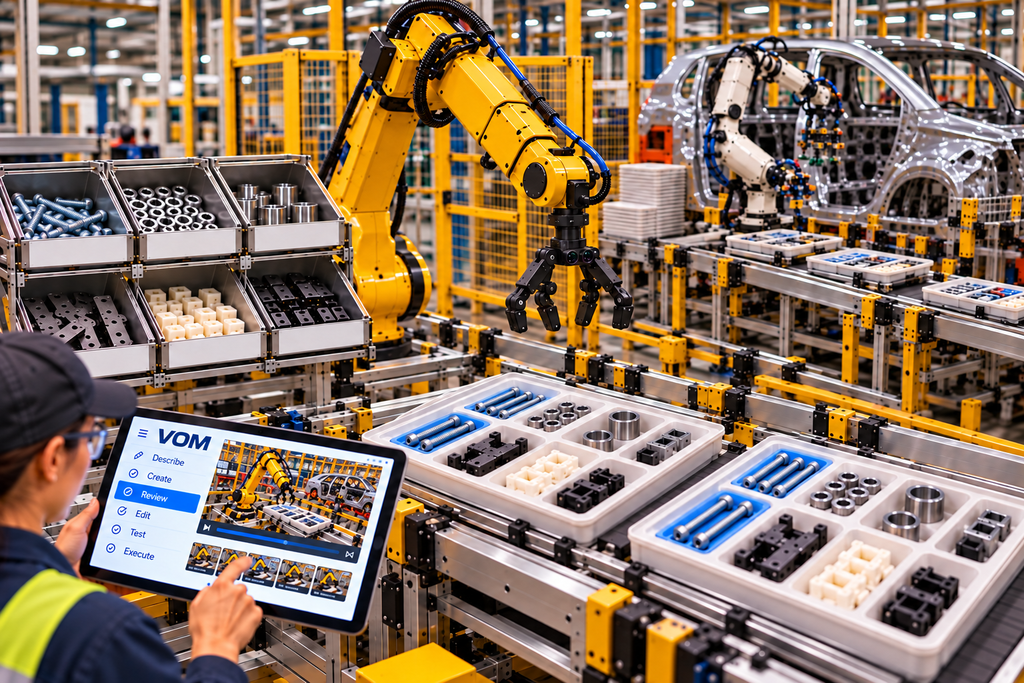
AI-DRIVEN ROBOT PROGRAMMING WITH VOM
Describe the task. Visualize the operation. Review and modify the program. Execute using a compatible robotic system
HUMAN CREATIVITY AND PHYSICAL AI
Much of today’s Physical AI development focuses on creating increasingly autonomous, general-purpose robots capable of performing a wide variety of physical tasks.
XXIICENTURY LLC is pursuing a different, complementary approach.
Rather than concentrating on developing an all-purpose robot, our objective is to provide people with AI-powered tools that enable them to create, visualize, modify, and implement physical automation using existing and future robotic systems.
The person remains the creator. AI becomes the means of transforming human intentions into physical reality.
The user defines the desired operation, evaluates the AI-generated virtual representation, and makes changes as necessary.
AI assists in developing the program and directing its physical execution.
This approach preserves human creativity and decision-making while reducing the technical complexity traditionally associated with robotic automation.
Just as generative AI enables people to create digital images, videos, and software, VOM is intended to extend similar creative capabilities into the physical world.
Our vision is to make creating physical automation as accessible as creating digital content with AI.
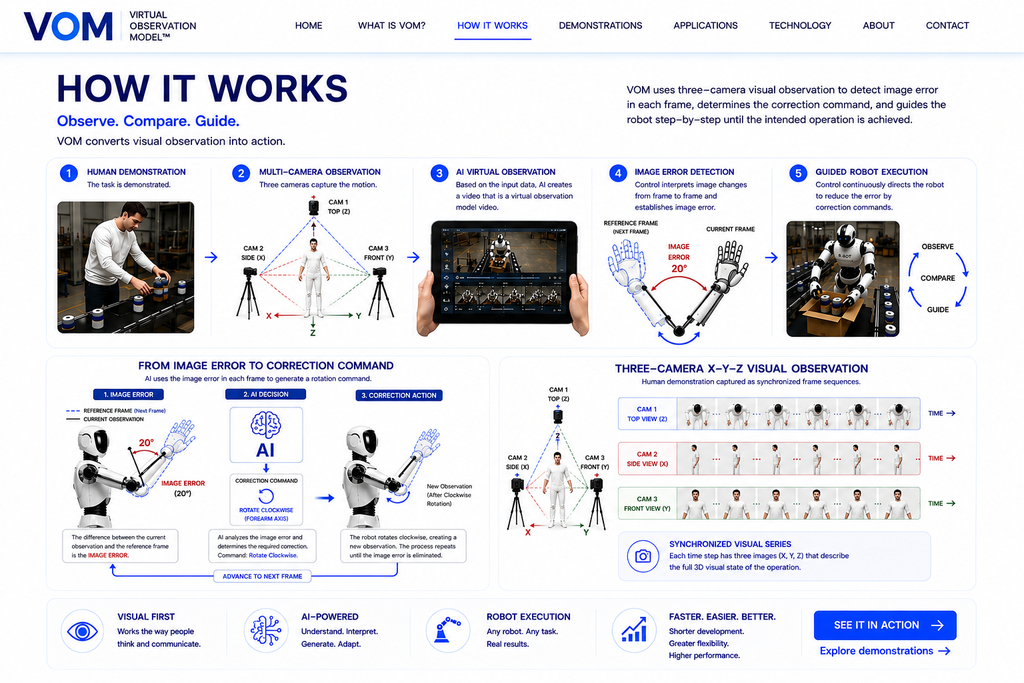
HOW IT WORKS
VOM allows users to create and run robotic programs by showing AI the workspace and describing what they want the robot to do. The user can watch the program AI creates, request changes, and test the operation on a real robot.
1. SET UP THE CAMERAS
The user positions three video cameras around the robot’s workspace to observe it from three different viewpoints. The cameras capture images of the robot, the objects, and the surrounding workspace at the starting position. These images are provided to AI.
2. TELL AI WHAT YOU WANT THE ROBOT TO DO
The user describes to AI what they want the robot to do, including the objects to be handled and how the operation should proceed. AI uses these instructions together with the images of the workspace to prepare the requested operation.
3. AI CREATES THE VISUAL PROGRAM
Using VOM technology, AI creates a visual program showing how the robot will perform the requested operation. The user can watch the program as a video on a personal device, such as a computer, tablet, or smartphone.
4. REVIEW AND MODIFY THE PROGRAM
The user watches the video and decides whether the proposed operation is acceptable. If changes are needed, the user tells AI what to change. AI modifies the program, and the user reviews it again. This process can be repeated until the user is satisfied.
5. LOAD AND RUN THE PROGRAM
Once the user is satisfied with the visual program, they can use the VOM application to load it into a compatible robotic control system and begin testing the operation on the actual robot.
6. OBSERVE AND MODIFY THE OPERATION
The user watches the robot perform the operation while also observing the visual program on their personal device. If any part of the operation needs to be changed, the user can tell AI what to modify. AI updates the visual program, and the user can review and test the revised operation. This process can be repeated for any part of the program or the entire operation until the results are acceptable.
This approach is intended to reduce dependence on conventional robot programming and enable more flexible interaction between artificial intelligence and physical machines.
COMPATIBILITY WITH EXISTING ROBOTIC SYSTEMS
An important objective of VOM development is compatibility with existing robotic equipment.
The technology is not dependent on developing an entirely new type of robot.
Instead, VOM is intended to provide an alternative programming and control interface that can potentially be adapted to existing industrial robots, collaborative robots, and future robotic systems.
Compatibility with particular machines will depend on their available control interfaces and the results of engineering validation.
This approach creates an opportunity to introduce AI-driven automation without requiring replacement of existing robotic hardware.
THE BUSINESS OPPORTUNITY
Artificial intelligence has already demonstrated its ability to generate images, videos, software, and other digital content from relatively simple user instructions.
XXIICENTURY LLC is pursuing a similar transformation in the physical world.
Our vision is to enable AI-generated virtual operations to become practical programs for robotic systems, allowing people to create and modify physical automation without requiring extensive knowledge of conventional robot programming.
When VOM technology is fully developed, it is expected to reduce the cost, time, and specialized engineering skills required to implement automation, making robotic automation practical for a much broader range of applications.
An important part of this opportunity is the ability to introduce AI-assisted programming and control capabilities to existing robotic systems, as well as future generations of physical machines.
Potential applications include manufacturing, packaging, material handling, logistics, laboratories, retail operations, and small-business automation.
Beyond individual robotic installations, we envision the development of AI-based services that enable users to create, modify, and deploy physical automation programs, much as today’s generative AI services enable the creation of digital content.
Our objective is to make physical automation easier to create, easier to modify, and economically accessible to a much broader market.